
Waves of Thought - Issue #1
Opinion on the implementation of AI
5/16/20264 min read


You Didn't Implement AI. You Installed a Bumper Sticker.
There is a service desk product used where I work, and the vendor is incredibly proud of one specific fact: it has AI in it. It says so explicitly on their website, it anchors their sales pitch, and it was almost certainly the headline of the internal memo announcing our latest corporate upgrade.
Here is exactly what that AI does: it allows users to open a support ticket electronically.
The process is admittedly smoother than it used to be. The form is intuitive, and the submission is clean. But here is what happens next:
The ticket lands in a standard queue.
A human technician opens it.
From that exact moment forward, everything works exactly the way it always did.
There is no AI assistance for automated categorization. There are no suggested solutions pulled from historical ticket data, no automated priority flagging, and zero pattern recognition across recurring issues.
The AI walked the customer to the door, smiled, and then went home.
The Applause Problem: Why Tech Demos Deceive
There is a predictable sequence of events when a business decides to implement artificial intelligence. Someone in leadership sees a competitor announce a feature, a vendor runs a dazzling live demo, or a board member asks why the company isn't doing more with emerging tech. A decision gets made, a feature gets turned on, and a satisfied checkbox lands on a strategic priorities list.
The customer-facing touchpoint is clean, visible, and easy to show off in a conference room. Leadership sees it working, the vendor calls it a success, and everyone applauds.
The Reality Check: Meanwhile, the people who actually process the work—the technicians, the operators, the staff who live inside that system eight hours a day—received a new ticket format and absolutely nothing else.
No new tools. No real-time assistance. No imagination applied to their side of the equation. The AI was implemented where it could be seen, not where it could actually be useful.
Silence Isn’t Satisfaction: The Deepest AI Trap
Here is the part that should deeply concern every business owner and executive reading this: the technicians at my workplace are not complaining. They aren't frustrated, they aren't filing internal feedback, and they aren't demanding better tools. They are simply working the way they have always worked inside a system they were told was upgraded.
And that silence is being counted by leadership as a roaring success.
This is the most dangerous feedback a poorly implemented AI product can receive, because the absence of complaint looks identical to genuine optimization. Nobody complains either way.
In a well-implemented system: Your people are thriving because their cognitive load has been cut in half.
In a poorly-implemented system: Your people are silent because they simply don't know what's possible.
You cannot want what you cannot imagine. Most enterprise workers have never seen AI implemented well enough to know what they are missing. The absence of a complaint is not evidence that you got the technology right; it is merely evidence that your people have adapted to friction. And that friction is costing you money, time, and efficiency every single day.
Following the Work: Where AI Leverage Actually Lives
Successful AI implementation always starts with a critical question that has absolutely nothing to do with technology:
“Where does the operational friction actually live?”
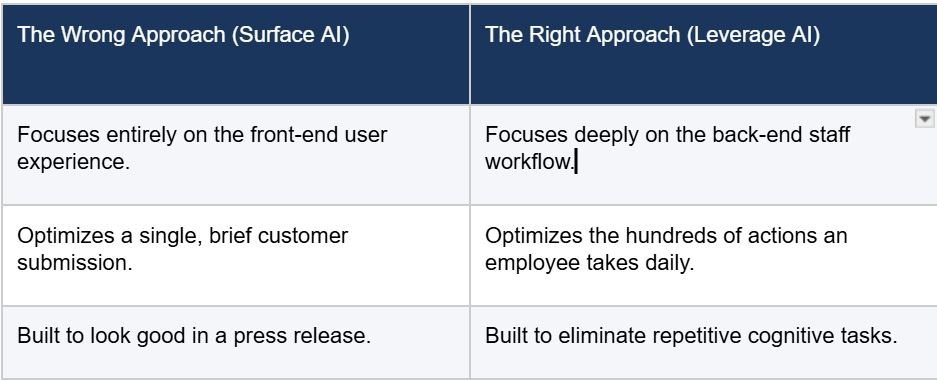
It doesn't live in the customer touchpoint, the marketing brochure, or the flashy feature built for conference room demos. It lives where your employees spend their time, their energy, and their mental load every single working day. That is where your AI belongs.
In a service desk environment, the technician workflow is where the true volume sits. The customer submits a ticket once; the technician works tickets all day long. Basic operational logic tells you exactly where the leverage is.
Good implementation follows the work. It requires asking the people doing the job what slows them down, what tasks repeat endlessly, and what variables they wish they didn't have to manually calculate. Only then do you apply AI to those specific bottlenecks and measure the delta.
That isn't a technology decision. It is a listening decision.
The Verdict: Moving Past the Lobby
To the technicians, operators, and specialists living inside these systems: I know you see the gaps. You are the ones figuring out workarounds before leadership even acknowledges a system limitation. You quietly know this could be better, but you've learned that speaking up rarely changes the software budget. Your silence isn't invisible—it's just being profoundly misread by the executives upstairs.
Businesses do not have an AI technology problem; they have an imagination problem.
The technology exists right now to make your workforce genuinely more capable, not just your customer portal marginally more convenient. The gap between those two outcomes is not technical. It is a question of whether leadership is willing to follow the work all the way to the back office where it actually happens, or if they prefer to stop in the lobby because the lobby is easier to show off.
AI that only works for the customer while ignoring the employee is not an enterprise implementation. It is a bumper sticker. It signals a value without doing the actual work to back it up.
Before you announce to the world that your business has embraced the AI revolution, walk down to the floor and ask the people processing the work whether they agree. Their answer might surprise you.
Contact
Questions or feedback? Reach out anytime.
© 2026. All rights reserved.
Receive our Newsletter